
Doctor Mary’s Day Off
Why doctors can’t spend 40 hours per week seeing patients


10 urgent tasks and 110 total. It’s a regular Thursday morning—my day off.
For primary care physicians - unless they regularly have appointment times that are not booked, or, for some reason, they seldom see complicated patients - it’s nearly impossible to see patients 40 hours per week because there’s so much paperwork and so many phone calls that have to be made.
I rarely have appointment times that are not booked, and most of my patients are complicated. For Doctoring Unpacked, I typically write about common ailments. As a result, most of my fictional patients here are less complicated than the real ones I care for. Readers will soon get to see what a complicated patient looks like, as that’s what is going to happen in my ongoing story about Lilly.
Complicated patients generate lots of paperwork. Although we still say “paperwork,” it’s all done on an EMR - Electronic Medical Record system. On days I see patients, I check the EMR in the morning and evening for tasks marked urgent, and take care of those as soon as I can. Nearly everything else I slide to the end of the week. I do not see patients on Thursdays or Fridays. By Thursday, I usually have around 120 tasks waiting to be done on the EMR. Sometimes it can be as many as 250. More pour in every day, regardless of whether I'm in the clinic or not. By Sunday evening every week, I get the previous week’s number to zero.
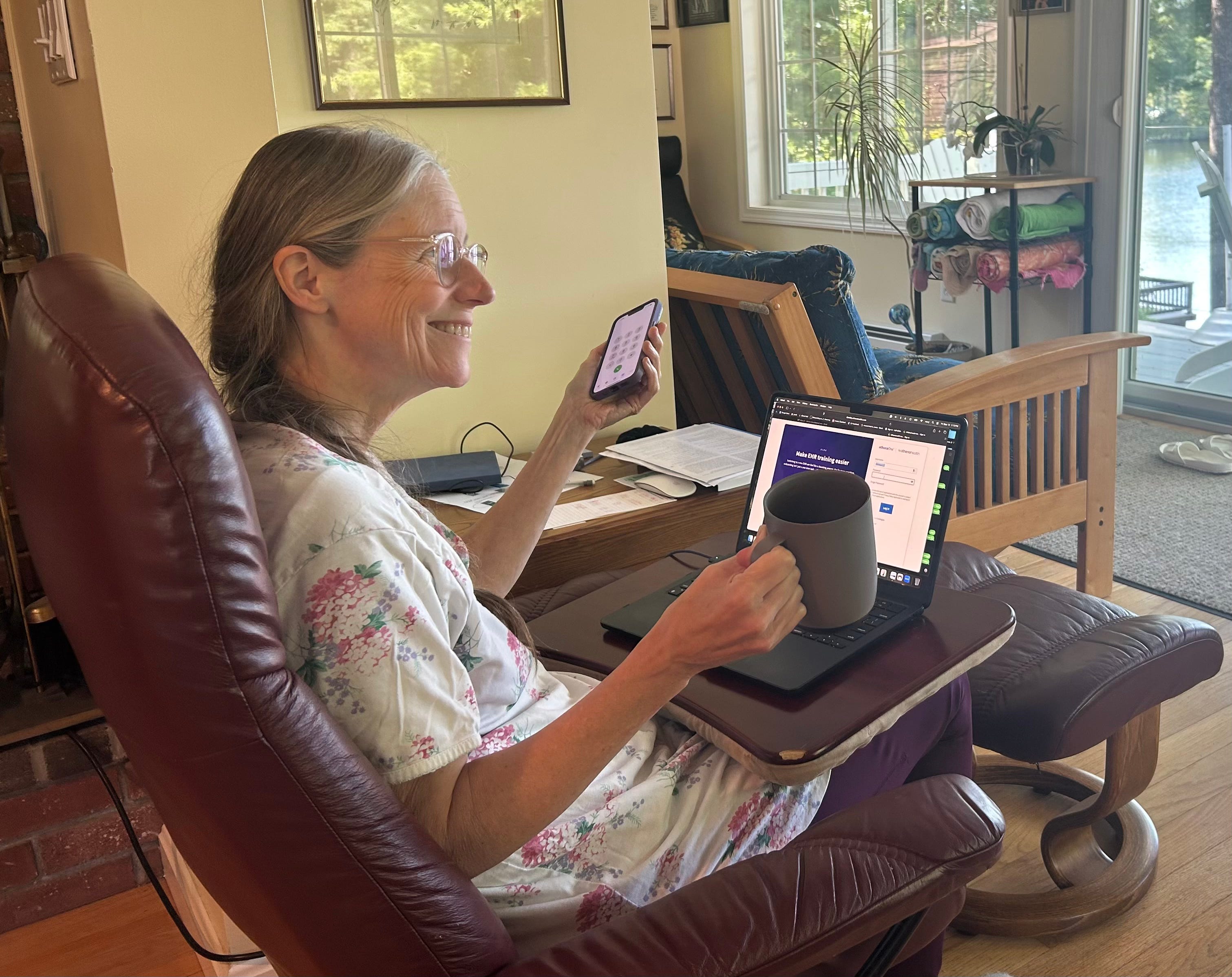
This morning, there are 109 tasks. I skim through the lab results that have been flagged as abnormal, which, for my patient panel, is almost all of them. I see nothing life-threatening. Later, I will go over these more closely and have nurses call the patient with my interpretations, but none of that needs to be done right now. These are all just routine abnormalities.
I move on to the urgent messages from the nurses. Today, there are ten of them. I check the first one. A pharmacy is refusing to fill a prescription for Oxycodone without a call from me, personally.
I pick up my phone and call. I go through the phone tree, and then I am put on hold with the same repeating fourteen-second music loop, interrupted every thirty seconds by a recording that tells me my call is important to them and they are experiencing a higher-than-usual call volume. Every three minutes, this is interrupted by a recording asking chirpily if I knew I could get my shingles vaccine from them.
It must be stressful to be a retail pharmacist these days. In the past 20 years, retail pharmacies lost several large-judgment lawsuits related to opioids. Some of the lawsuits were allegedly the result of management putting pressure on their pharmacists to fill opioid prescriptions quickly and without the scrutiny that the pharmacists thought should have been applied. There are various theories about why management did this, but the results were catastrophic, not only in terms of large numbers of patient deaths, but also economically, such as Rite Aid being driven into bankruptcy.
Once the pharmacies started losing in court, pharmacists were told to scrutinize every opioid prescription carefully and be absolutely sure that they were not filling a single prescription that anyone, ever, could claim was improper. The pharmacists responded by becoming paranoid. In response to only slight changes, as little as the usual pharmacist being away on vacation, pharmacies will commonly require us to call them before they will fill the prescription.
Many of these calls can be handled by our nurses. For example, a pharmacist might reject a prescription for a patient whose address is listed as a post office box and not a street address, or the pharmacist felt the diagnosis code did not justify opioids. In one case, the problem was that I had not also prescribed Narcan, which I hadn’t done because we’d already given the patient Narcan.
While I was in phone-hold purgatory, I wondered what the problem would be this time. After a few moments, I realized that I was wasting time daydreaming. I was likely to be on hold for a long time, and while I was waiting, I could simultaneously work on something else on my do-list. I decided to text my Substack friend Bronce for a therapist’s input about my patient Taylor, who has exhibited psychological issues associated with excess weight. You can read Bronce’s essays at The Wellbeing Equation.
I must have caught him at a good moment because he responds right away.
MB: Hey, Bronce! I hope you're doing well. I have a patient on a GLP-1 who I thought was going to be straightforward, but now I'm hearing things from her that sound an awful lot like an eating disorder, like that she believes her kids are embarrassed to be around her bc her BMI is 48, and that she'll only be beautiful if she loses weight. How can I tell the difference between “I'm overweight and I don't like how much I weigh” and “I'm overweight and have an eating disorder?”
She had pretty good eating habits before the GLP-1; she's super busy and eats a little bit of junk food on the go, but cooks at home, and tells me that she's conscious of eating protein and reducing empty calories, etc.
She doesn't do bingeing or purging or compulsive exercise--she's told me 1,000 times that she's too busy to exercise.
BR: Hi Mary, it’s nice to hear from you again.
It sounds like your patient has a relatively stable (though distressed) relationship with food, eating mostly at home, not over-relying on highly processed foods. I'd worry if she showed signs of chaotic cycles around food intake like: restricting heavily then losing control and overeating, sneaking or hiding food, frequent guilt/shame episodes tied to eating, rigid food rules that caused her distress if she broke them, or she tried to ‘make up for eating’ by vomiting, using laxatives or diuretics, or exercising compulsively.
You’re right to worry about her self-loathing and her belief that her worth and beauty hinge on her weight. That cognitive and emotional overlay, feeling “ugly,” or that her children are embarrassed by her indicates significant body image distress, which is a core component of disordered eating, even if not rising to full eating disorder criteria. If her children are teenagers, some of that perception may reflect ordinary adolescent dynamics, but her interpretation of it specifically through the lens of body size suggests a cognitive distortion fueled by shame. In other words, the risk here is less about a specific eating pathology in her behavior and more about the internalized shame and conditional self-worth tied to her body size. In distinguishing “I don’t like my weight” from “I have an eating disorder,” I’d say your patient currently falls closer to the former but with psychologically risky features that could tip into the latter if not addressed.
MB: I know! She won't see a therapist, and I'm worried about her. I think losing weight will help her physical health, but I'm worried about her mental health!
BR: The intensity of her self-criticism suggests a fragile sense of self tied almost exclusively to weight outcomes.
MB: I'm out of my depth here, Bronce! Is there anything I can do to bolster her sense of self? It seems like not really--I mean, that's entirely internal to her. Is there anything I can do to help?
BR: You’re in a tough spot here, it’s not easy when you can see both the medical progress and the psychological risk, but the patient isn’t open to therapy. It may help to normalize how common it is for people to carry shame about weight and to feel conflicted about health goals.
You can stress that she can feel good about the medical and physiological benefits she’s already experiencing: appetite regulation, easier movement, and improvements in any related conditions, so her sense of progress isn’t limited to her outward appearance.
At the same time, you can begin, gently, to explore how she talks to herself about her weight. That opens the door for her to reflect on the origins of those inner voices and the pressures shaping her beliefs: “I hear how much pressure you feel to look a certain way. Can you tell me more about where those voices started, or where they come from?”
I have to stop texting with Bronce because a pharmacist has finally taken my call.
And yes, doctors being put on hold by pharmacies this long is common, and no, I don’t get paid for this. Some pharmacies have a special option for prescribers that puts us to the head of the queue, but most don’t. I wait in the same phone-tree hell that you do.
I tell the pharmacist that I’m a prescriber and I identify the patient. The pharmacist takes a moment to pull up the patient’s record and then tells me, “You have written a prescription for more pills than I am allowed to fill.”
I look through the patient’s chart. He had been on 60mg of Oxycodone three times daily, and he thought he could decrease it. Not only are pharmacists under management pressure about opioids, but physicians are, too. We’re under pressure to prescribe less. It’s so bad that some doctors outright refuse to prescribe opioids, and refer such patients to a pain clinic, subjecting the patient to extra appointments and copays.
The plan the patient and I devised was to switch from 60mg tablets to 30mg tablets. Most of the time, he would take two for the same dose, but when he felt like he could take a smaller dose, he could take only one. To apply some pressure to decrease, we’d reduce the number of pills he’d receive per month by 10, so for 10 days out of 30, he’d have to spend a third of the day on half of his normal dose. He felt this was a bit of a challenge, but doable. I thought the plan was a safe and likely to be effective. All it would take would be a simple change in the prescription. Instead of prescribing 90 tablets of 60 mg each, I’d reduce the Oxycodone by prescribing 170 tablets of 30 mg each.
Simple for me, but apparently, not for the pharmacist, who tells me, “I am not allowed to fill an opioid prescription for more than 144 tablets at a time. You could decrease the number of tablets for me to dispense to 144, and make it a less than a 30-day prescription, or you could write two prescriptions: one for some 60s and one for some 30s.”
“If I wrote a script for 144…. Why 144? Sorry I asked. Let’s not get distracted. If I wrote a script for 144, and wrote on it, ‘for 24 days,’ and then he came in on the 25th day and filled a new one, would that be okay?”
“Yes. There is not a rule about how often I can fill prescriptions. There’s just a rule about how many pills I can give at a time. It would be better to do two prescriptions, one for 60s and one for 30s.”
“I think having him be on some 60s and some 30s is not a safe option because he might get them confused and accidentally take a 60 when he meant to take a 30. It’s very easy to do, especially in the middle of the night if your pain has awakened you.”
The irony of the pharmacist recommending to me an option that is less safe for my patient because his employer has created this rule in the guise of patient safety is not lost on me. I don’t say this to the pharmacist. It’s not his fault. He probably already feels bad enough. Besides, he doesn’t know the patient. Just as this call is a waste of time for me, it’s the same for him. He’s talking to me instead of filling prescriptions, and like me, he’s not getting paid for it. He gets paid for filling prescriptions. In the infinite ignorance of the bureaucrats, this make-work is supposed to make things better. Of course, the bureaucrats are trying to do what they think is best, too, but while I’m after ‘best for the patient,’ they are aiming at ‘best for XYZ pharmacy.’
“Okay. I think we’ll keep the plan the same and just tell the patient’s wife she has to come in earlier for a refill. Who knows? Perhaps the patient will be able to taper down, and 144 will be enough for 30 days. Do you need a new prescription?”
I know that technically the answer should be no because a pharmacist is allowed to fill any prescription for less than the amount written, but since we’re dealing with pharmacist paranoia about opioids, he may feel more comfortable with a new prescription, and I don’t want the pharmacist stressed out over stupid stuff that I can easily ameliorate.
“Yes, then my manager can see that I made you aware of our policy and we engaged in collaborative problem solving.”
I end the call as quickly and politely as I can, because I desperately want to sarcastically retort, “Oh, so that is what collaboration looks like: you tell me how it’s going to be based on the rules of someone who has never been a clinician.”
The call ends, and I release my retort to my teacup.
My husband, who has been sitting quietly next to me in our living room, asks me if I’d like more tea.
Drinking hot tea has a calming effect.
While he gets me tea, I write a note in the EMR to my nurse asking her to contact the patient and his wife and explain why they now have to make additional make-work visits to the pharmacy. I send a revised prescription to the pharmacy. Then I do a mental scan over all my patients who get a lot of opioid pills a month. Only one patient comes to mind who gets more than 144 tablets a month. I look her up on the EMR. She uses a different pharmacy. Thank goodness! I make a mental note to think about this new wrinkle whenever I write an opioid prescription.
Now that I’ve gotten this bureaucratic waste of my time out of the way, I return to my conversation with Bronce. This will help me feel more grounded before I go on to the other 110 things on my virtual desktop.
You may remember I started with 109. Two more have come in while I was getting my first one done.
MB: Arg, Bronce! I barely have time to do the medical stuff in a visit! That would be a whole can of worms, I bet and I'd be afraid if I opened it and didn't have time to deal with the consequences that I'd be harming her more than helping. Sometimes I envy therapists for their 45-minute sessions with each patient/client.
BR: I get it—you’re in an incredibly tight spot. You’ve only got minutes, and it feels risky to open something you can’t close within that timeframe. That’s a real concern, and it makes sense you’d hesitate.
One thing you can do without opening the whole can of worms is to validate her struggle briefly and recommend therapy as the space where she’ll have the time to work through it fully. Even a simple line like: “I hear how painful this is for you, and this is exactly the kind of thing a therapist can walk through with you in more depth than we have time for here” can normalize the need. You might also frame it as a small step, suggesting she try just a few consultation sessions with a therapist to see how it feels—that way it doesn’t come across as all-or-nothing.
MB: I know she would benefit from a therapist, but she's already running around like a chicken with her head cut off. I could tell her that I'll only give the med to her if she's in therapy, but I don't feel like that kind of power play works out well ever and enforced therapy is no fun for anyone. I'll keep trying to convince her.
BR: You’re right—enforced therapy rarely works. One thing you can do, even briefly, is to ask explicitly about disordered eating behaviors.
For example:
Do you ever eat in secret?
Do you ever feel out of control with food?
Do you ever skip meals on purpose?
Do you ever try to “make up for eating” through vomiting, laxatives, or over-exercise?
A new urgent task pops up on my EMR. An assisted living facility just called. Yesterday, one of my patients, Mabel, was short of breath. I ordered an X-ray. The results have come in, and they’re consistent with congestive heart failure. The facility wants me to tell them what they should do about it.
I can’t possibly see this patient until next week at the earliest. Managing heart failure without seeing the patient is a challenge. Mabel is 98 years old, frail, difficult to transport, and is reluctant to leave the facility. The easiest option for me, and in some ways, the safest for her, would be to send her to the Emergency Department and let someone there manage her as the textbook says heart failure should be managed rather than in the somewhat ad hoc way I would have to do it, based on what is available at the nursing home and what the staff can do.
The easiest option for me is the nastiest option for the patient. I don’t feel great about sending Mabel to the Emergency Department, where she will be exposed to every virus in the community. People who are 98, even a robust 98, can get confused in a new environment, especially when they are sick, and fall and end up with worse problems than they went in with. Besides, if she arrives when the Emergency Room is busy, she’ll be low priority and will be there for many hours. She may have to sit in a crowded waiting room for a long time, without someone to help her to the bathroom or get her a drink of water.
Mabel knows enough about Emergency Departments to know she would not want to go there.
I could try to manage her at the assisted living facility. That would entail getting labs, getting the facility to fax me the labs, giving her an extra water pill, finding out from the facility if it worked or not, adjusting the dose as needed, and getting another set of labs in the morning. The facility would need to weigh her daily and let me know how she was doing - an evaluation I’d have to rely on, an evaluation coming from someone I don’t know.
I could have her schedule an appointment at the clinic with someone else. Although if she’s leaving the assisted living to see someone she doesn’t know, she may as well go to the Emergency Department, where they can do labs and get the results back quickly.
I know how much Mabel hates going to the Emergency Department. I know she’ll complain bitterly at their next visit with me, but I tell the nurses to tell the assisted living to send her to the hospital. If Mabel had family nearby who could drive her, she could go to Urgent Care. Their waits are shorter, they are not overcrowded with sick people, their environment is calmer, and they have all of the equipment Mabel needs: X-rays, IVs, and labs. It would be exactly the right level of care for her, but the assisted living doesn’t have staff to take her there, and Urgent Cares don’t accept ambulances.
The nurse tells me she can get labs done today and have the results back in a few hours, that Mabel really doesn’t want to go, that she’s comfortable now, and that they both think she can be managed at the assisted living. Against my better judgment, I cave. Mabel will be happier staying there, the nurse assures me she can follow my orders. We exchange cell phone numbers.
I document my conversation with the nurse and the orders I gave. I have just made a lot more work for myself, but I do highly value the happiness of 98-year-olds.
Forty minutes ago, I sat down to work. I have now accomplished two of my tasks. The list of tasks assigned to me on the EMR has returned to 110 - one more than I started with. This is typical. It’s during business hours. Our nurses are making and receiving calls, and laboratories are sending in results. On the other hand, the urgent tasks are, on average, more time-consuming than most of the other tasks, and I’m focusing on those first.
I return to my texting conversation with Bronce.
MB: It would be so easy for her to lie to herself about the "skip meals deliberately" one. I mean, she's so busy, she could tell herself, "I'll eat later," and then it's bedtime, and she realizes she hasn't eaten. Did she deliberately skip a meal? That's interesting; it's a bit of a gray area that I bet many of my patients would say 'maybe' to if they were being honest.
BR: Exactly—that’s where it gets tricky. Skipping meals can sit in that gray zone between “I was too busy” and “I was deliberately restricting.” Sorting that out takes time and trust, which is why she really needs a therapist. You might also just name the grayness with her directly, that it’s hard to know sometimes whether we’re being honest with ourselves. Even putting that tension into words can make a patient feel seen and open the door to deeper reflection later.
MB: I really love to talk with my patients about that stuff, but I have so little time. >sigh< Speaking of which, thanks for taking so much time to help me sort this out. I am not as worried about the eating disorder, but now I'm really worried about how I'm going to help her stay mentally healthy going forward.
BR: The goal really is prevention—keeping her from sliding further into disordered patterns, while also helping her face the underlying drivers of her shame, body image distress, and her fragile sense of self as her body changes. You know, easy stuff, Mary. Let me know how it goes! I’m here if you need another supportive ear, and who knows down the road you may have more clinical details that could help us think it through together.
MB: OK. Thanks for coaching me through this, Bronce. I think I have some ideas now.
I stop texting and return to reviewing tasks on the EMR. I have nine more urgent tasks to get done. That will probably take about two hours. Dealing with the abnormal labs will take maybe four hours. The remainder are FYI things that will take me about an hour to read. Some examples:
A patient visited a specialist, and they want to see them back in a year.
A patient wants to let me know their back is better or their specialist appointment got moved sooner.
A patient was treated correctly by the emergency room for a problem that doesn’t need follow-up, and I know they will call if the treatment doesn’t work.
Labs and imaging studies ordered by specialists that don't have surprising findings in them.
Requests to sign off on orders that nurses are allowed to do by protocol.
Tomorrow - Friday - the volume won’t be as bad. A small amount will come in on the weekend, mostly about visits to the Emergency Room and Urgent Care, or about patients in assisted living.
My husband interrupts my work, “If we’re going to take a walk today, we’d better get to it. It’s going to start raining in an hour, and rain the rest of the day. If we don’t get out now, we’ll have to go to the gym later in the day.”
While I feel like I’ve spent the first part of my morning on a treadmill running hard to stay still, he’s right. We need to get in our exercise. I have been so busy, I haven’t exercised since Sunday.
I say, “Okay. I’ll do our stupid walk for my stupid physical and mental health.”
During our walk, I vent my frustrations about the ordeal with the pharmacy. I suppose that’s good for my mental health, because I end up feeling better. By the way, if any readers know a good reason for the 144-pill limit, please let me know!

* As usual, all of the patients mentioned here are based on real patients, but are not themselves, patients. Nor is the pharmacist a real pharmacist, nor was the number 144. Details about all of these things have been changed to maintain anonymity. Any resemblance to real people is accidental. The resemblance among numbers, I cannot do much about.
**Nothing in this article is or should be construed to be medical advice. If you want that, please contact your primary care provider whose front desk staff will write an electronic case and your provider will get back to you.
 | A guest post by
|