
Pissed Off and Passed Around
Behind-the-scenes insight about why the healthcare system acts the way it does.

“I’m kind of annoyed. I think this is a stupid reason for me to have to come in. I am sure I have a UTI. I’ve had pain when I pee for three days. I took some of the over-the-counter azo stuff for a couple days to get to my appointment with my lung doctor this morning. I thought for sure I could tell him I had a urinary tract infection and he could just give me an antibiotic. Instead, he said to call my primary. She’s off today, but thank you for taking me in.
“I mean, he knows how to prescribe an antibiotic. He’s given them to me before. I don’t know why he wouldn’t just do it!”
Paula was a 42-year-old woman who usually saw my co-worker, who was out for the week. I happened to have a last-minute cancellation, so the front desk put her on my schedule.
“Well, Paula, I can speculate, and if we have time at the end and you want to hear it, let me know, but for now, let’s take care of what you came in for today, okay?”
“Sure,” she grumbled.
“Chloe dipped your urine already, and it looks pretty clearly like you’ve got an infection, and your symptoms sound like it, too. Does this feel just like the other ones?”
“It sure does.”
“Nothing else to go with it? Fevers? Chills? Nausea? Blood? Vomiting? Eating like normal?”
After each question, I pause, and Paula shakes her head, until the last one, when she laughed and said, “You almost had me there! No, I’m eating like regular.”
“Anything going on with your poop?”
“Nope. Just like regular.”
“Good. Back pain?”
Paula shook her head.
“Ever had stones?”
“I did, a long time ago, and this doesn’t feel anything like that.”
“Okay. Let me take a quick look at your chart.”
I scanned the sections quickly. Not on any meds that should affect her bladder or immune system, not on any chronic antibiotics, not on anything that should interact with an antibiotic, no past medical history that would affect her immune system or bladder functioning. I saw that the kidney stones weren’t noted on her previous medical history. I added them.
“Okay. It looks like this is a nice, uncomplicated urinary tract infection. Let me examine you and we’ll get you on your way.”
I gesture to the exam table, and she hops up.
I put my left hand on the left side of her back, over her kidney. Then I punch my left hand with my right hand. The transfer of kinetic energy from my right hand to Paula’s body will cause her kidney to move a bit. If she has stones or if the infection has spread upwards from her bladder, this usually is very painful. If the infection is still confined to her bladder and she has no stones, the punch won’t hurt.
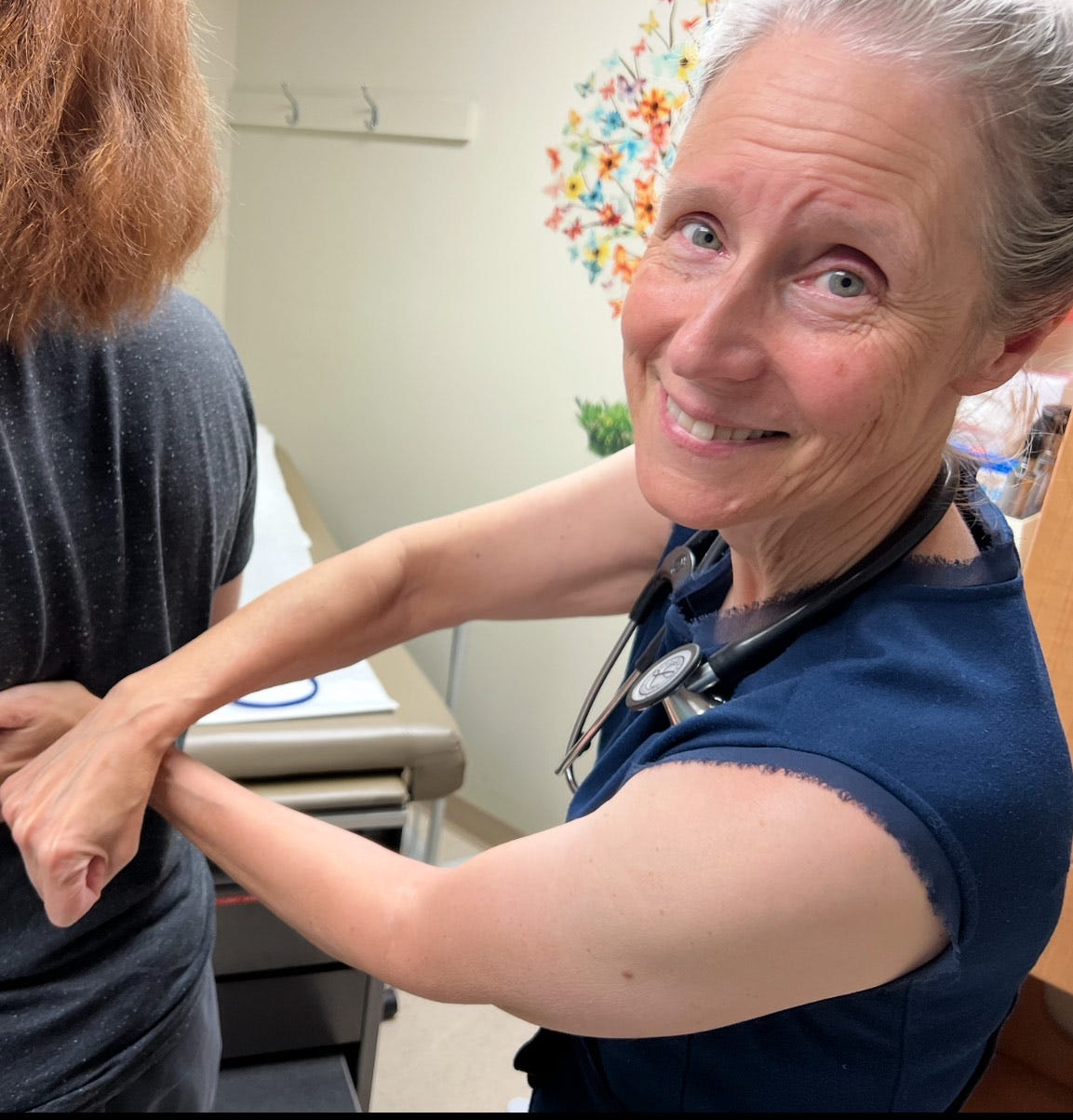
No pain on the left side. I do the right side. No pain there, either.
“Okay! It looks like you just have a simple UTI.”
If the infection had spread to her kidneys, it would limit which antibiotics I could use, and it would mean the nurse should call her to check on her tomorrow. If I thought she might have stones, I would want to do some imaging to find out if they were causing any specific problems.
“I see you don’t have any antibiotic allergies, and you haven’t had any antibiotics recently, so I think I will treat you with the usual mildest antibiotic. You take it twice a day. Pick it up today. It’s late enough in the day that you should just take one today, then on the last day you’ll just take the last pill in the morning.”
I give this advice to everyone I start on an antibiotic. I have learned that if I don’t tell people to pick it up today, sometimes they will pick it up tomorrow or the next day, even though they have an uncomfortable infection. I have also learned that if I don’t tell people to start their medication immediately, they will sometimes wait until the next day in order to follow the instructions to take two in a day. If I don’t tell them to take the last one that is left over on the last day, sometimes people will not take it at all. Again, this is for the same reason: they’re following the instruction to take two per day.
One of the big things I’ve learned as a doctor is that there are an amazingly large number of ways to misinterpret almost anything.
As I give my memorized speech about taking antibiotics, I sit at the computer and send Paula’s prescription to her pharmacy.
Thinking that we’re done, I stand up and prepare to leave.
“You said you’d explain why the lung doctor wouldn’t give me an antibiotic,” Paula reminded me.
I sit back down. My heart sinks a bit. On one hand, I don’t like trying to guess why other doctors do what they do, and on the other hand, I was hoping that I’d have a few minutes free before my next patient so I could have a snack and sign off on a couple of the urgent things I know are sitting on my desk. But Paula was right. I had told her that I would address that for her. Her asking about it also means that being angry at her pulmonologist is not her main emotion. I can do him a small favor, help her dispel her bad mood, and help her understand a little bit more about how the health care system works. If I’m lucky I’ll have a no show later.
“Well, there are several reasons for it.
“First, there’s the problem of knowing what medications you’re on. In theory, every doctor you see is supposed to know, but in practice, the only person who knows what medications you’re on is you. While some information about medications does travel from one doctor’s records to another, most of what any doctor knows about your medications is what you’ve told their assistants, and often how they check your list of medications no more involved than asking you, ‘any changes to your med list?’ If the assistant hasn’t reminded you when you were in last, that question is completely useless. Even if the assistant does do that, it’s a rare patient who can remember that nine months ago they were taking a different birth control tablet than they are now, for example.”
Paula nods and says, “Not to throw her under the bus, but she did ask if there were any changes and I felt like I had to answer right away because she had so many questions to get through.”
“Yep. They do. The medical assistants are required to ask so many questions that it’s near impossible to get a patient in a room in the time they’re allotted. Keeping track of medications is a big deal because lots of drugs interact with each other. Watching out for these interactions is your primary care physician’s job. Consequently, your specialist is not as likely to have a full list as we are.
“Second, if you’re a specialist, you’re not keeping up to date on things outside your specialty. Your lung doctor may not have thought about UTIs since he was in med school, and that could have been decades ago. No one can keep up with everything, and it’s not really his area. The antibiotics for urinary tract infections are not quite the same as the antibiotics for lung infections because different bacteria cause trouble in the two places.
“Third, he almost certainly doesn’t have the things on hand for diagnosing UTIs, such as urine cups and equipment for a urine dip.
“Then, on top of those medical reasons, there’s also a financial reason.”
“I knew it! Follow the money!” Paula crowed.
“Yes, we doctors get paid for each patient we see, and we get paid a little more for more complicated visits, where the patient has more problems. However, there’s a limit to that, and the limit is set such that we doctors are usually operating at that limit. Your lung doctor was probably already billing at that limit. Adding treating your urinary tract infection would not increase what he would get paid. However, it would add to his work. He’d have to diagnose you just like I did. Then he’d have look up what antibiotic to use, how to dose it, and make sure it wouldn’t interact with your other meds. This is all stuff he would not do efficiently because he’s not in the routine of doing them. On top of that, there’s always the chance something will go wrong with the prescription. That could mean his nurse would have to wait on hold for twenty minutes to clear up something with the pharmacy, or have to play phone tag with you. It’s so much easier for doctors to just stick to what we already do and have the patient go through the proper channels.”
“But that made a lot more work for me!”
“Yes, it did. It wasn’t always this way….”
I pause for a moment to reflect upon what I was getting myself into, and to resign myself to the fact that I was blowing my chance for my usual afternoon snack. Paula, however, had given me an opportunity to discuss one of my favorite topics: the unexpected consequences of change in the medical system.
“Back when I was a whippersnapper, we doctors used to know how to pick up a phone and tell other doctors that a mutual patient has a UTI and needs an antibiotic called in. Back in the day, we used to all go to the hospital, where we’d see each other in person, which made it easier. We’d share our back office numbers with each other, and then later, our cell phone numbers. Now, everything at the hospital is done by hospitalists, so we almost never meet in person, and very few clinics have back-office numbers anymore.
“On top of that, now we’re all terrified that we might somehow violate a patient’s privacy. So, we can’t use our personal phones, which means when we call each other, we have to go through phone-tree hell to do so. Even when I have another doctor’s personal phone number, if I send them a text asking them to call me about a mutual patient, my requests are frequently ignored. We’re all overwhelmed with what we absolutely have to do, so we don’t have any time for any niceties anymore. I don’t think it’s personal. I think it’s just because everything in the medical system is starting to collapse.”
“Well, that’s cheerful, but I do have to agree. I have another question: why do women get urinary tract infections and men don’t?”
“This one is just due to differences in plumbing. Do you know where the bacteria in a urinary tract infection come from?”
Paula shook her head, “I always wondered about that.”
“Well, it’s pretty disgusting. The bacteria initially come from your anus!”
Paula’s eyebrows shot up.
“If you think about it, your anus and your urethral opening are less than an inch apart. I always think the real wonder is that we women don’t have more infections! For men, any bacteria would have to go up the whole length of the penis to get to the bladder, you know, depending on who’s measuring, 3 to 6 inches!”
Paula thought this was as funny as I hoped she would. When she had settled down, she said, “That’s why we wipe from front to back?”
“Yes. And anything that makes the whole environment more comfortable for any bacteria that happen to be out and about, so to speak, increases the chance of getting a urinary tract infection: wearing a wet swimsuit for a long time, urinary incontinence with a wet pad, and for some women, sex. Fortunately, our vaginas are nicely acidic to make it harder for bacteria to grow and, interestingly, menstrual fluid has many antibacterial properties.
“That is interesting! Thank you! I appreciate your answering those questions. I have a couple more.
“Why do primary care doctors move so often? I’ve had three doctors assigned to me in the past five years, and I’ve never met any of them more than once or twice. And, when are you retiring? Can you be my doctor? ”
I laughed.
“A full answer would take more time than either of us has. I think it’s just another symptom of how the system is falling apart. All of us are working too much and too hard. For decades now, our pay hasn’t kept up with inflation. The way practices get run is not as stable and predictable as it once was. They’re much more affected now by outside shocks and changes in management. So, when we think the grass is slightly greener over there, we change jobs.

“Of course, it’s important for everyone to have a consistent source of primary care, but for a healthy person like you, it’s less important than for a 75-year-old with multiple conditions. If you had multiple or complex chronic conditions, your primary care provider would be making an effort to see you, but for people like you who come in once a year or so with something acute, you get whoever can see you first.
“And even in primary care, we specialize. Some of us are really interested in reproductive health or mental health issues. People who see lots of younger folks are very adept at diagnosing and treating STIs. Me? I haven’t seen one in fifteen years.
“I particularly like taking care of people with multiple chronic illnesses, where we are balancing one organ’s needs against another’s. I hope you’ll take it as a bit of good news that you’re too young and healthy to be one of my patients. All you have is asthma.”
“And a UTI!” Paula chimes in.
“Yes, but for us it’s all garden-variety stuff. That’s why you’re assigned to a nurse practitioner. For the garden-variety stuff, they have the same training that I do, but they don’t have to go to school as long to cover stuff that I deal with.
“Besides, I plan to retire in 3 to 4 years, and my panel of patients has been full for a long time. You should be with a younger doc, one who will be with you a long time. I think the nurse practitioner you have now will stick around.”
“And maybe not. It all looks like a revolving door to me.”
“I hear you there, Paula. I see on your chart that you don’t have a physical scheduled. Let’s get one scheduled now. If you call close to when you’d like a physical, you’ll just get put with whoever has an opening, but if you do it farther in advance, even if your nurse practitioner’s schedule changes, our front-desk people will try to make sure you see her and not some other provider.”
At this point, not only am I not going to get my snack, but I’m now running a little over. There’s also no billing code for time spent with patients explaining how the healthcare system is falling apart, but it was time well spent. Paula has a better understanding of how medicine works and how to obtain more consistent care.
Also, her nurse practitioner is my officemate. I happen to know she just bought a house. I am pretty sure she’s not going anywhere soon.
*Paula is a patient amalgam, made up from other people's patients who are not that happy to be seeing yet another doctor.
**Nothing in this article is or is meant to be taken as personal medical advice. If you want that, please call your personal medical doctor and deal with their phone tree hell.
Your reflection on how doctor-to-doctor communication has changed over the years really resonated with me. The image of doctors connecting in person at the hospital, sharing back-office numbers, it paints a picture of a more fluid and, dare I say, human system. It makes me think about how much of our professional lives, across all industries, have shifted away from informal, personal connections towards more formalized, often digital, and sometimes frustrating pathways.
It’s a subtle but significant point, isn't it? That the loss of these "niceties"—the easy phone calls, the quick chats—isn't just about convenience, but about a deeper unraveling of collegiality and efficiency within the system. It speaks volumes to the pervasive impact of increasing workloads and privacy concerns on even the most basic collaborative functions.
I think most of us have run into these issues. People of a 'certain' age (me) remember my specialist dr. being able to handle other issues beside their specialty years ago. Things have definitely changed. My parents' primary went on "sabbatical" a year ago. I remember chuckling to myself and thinking she's never coming back. She never did.